
OSG FIELD GUIDE
18 AUG 2026
FAA Issues Revolutionary Approval to NYPD for Drones
Subject-FAA Issues Revolutionary Approval to NYPD for Drone as First Responder Operations Without Visual Observers
On September 23, 2024, the Federal Aviation Administration (FAA) granted the New York City Police Department (NYPD) a landmark approval that significantly advances Drone as First Responder (DFR) operations. The authorization allows NYPD to conduct beyond-visual-line-of-sight (BVLOS) drone flights across much of New York City without visual observers and without the need for costly detect-and-avoid (DAA) systems such as radars or electro-optical sensors.
This approval marks one of the most advanced public-safety drone authorizations issued to date. It enables simpler, more scalable DFR deployments in complex urban airspace and provides a practical blueprint that other law-enforcement agencies across the United States can follow.
1- What the Approval Enables
The waiver centers on three core elements:
Shielded DFR Operations
NYPD may operate drones up to 200 feet above ground level (AGL) or within 50 feet of structures. In dense urban environments, this “shielded” volume sits well below the typical altitudes of crewed aircraft (generally 500 feet AGL or higher), reducing the risk of mid-air encounters.Skydio Autonomy
Advanced obstacle-avoidance technology allows safe flight near buildings, terrain, and other obstacles—including at night—mitigating the elevated collision risk that comes with lower-altitude operations.ADS-B In Integration
Automatic Dependent Surveillance–Broadcast (ADS-B) receivers provide real-time awareness of nearby aircraft. Operators receive alerts with relative altitude, location, and distance data, enabling informed decisions about whether an avoidance maneuver is required. No additional DAA hardware is mandated.
Additional operational features include fully remote piloting (no on-site personnel required with the aircraft), operations in both uncontrolled airspace and controlled airspace up to FAA UAS Facility Map altitudes, and the ability to launch, fly, and recover missions from remote locations.
2- Why This Matters for Public Safety
Drone as First Responder programs deploy aircraft to emergency calls ahead of ground units. Live video feeds give officers critical situational awareness, improve response times, support more informed decision-making, and can reduce the need for higher-risk interventions. Prior to this approval, many agencies faced high barriers: the expense of radar systems that perform poorly in dense urban environments, or the ongoing personnel cost of staffing visual observers.
By removing those requirements while maintaining safety through shielded operations, autonomy, and ADS-B, the FAA has lowered the friction for scaling DFR programs. New York City’s complex airspace makes the approval especially significant; if the framework works there, it can be adapted to less constrained environments nationwide.
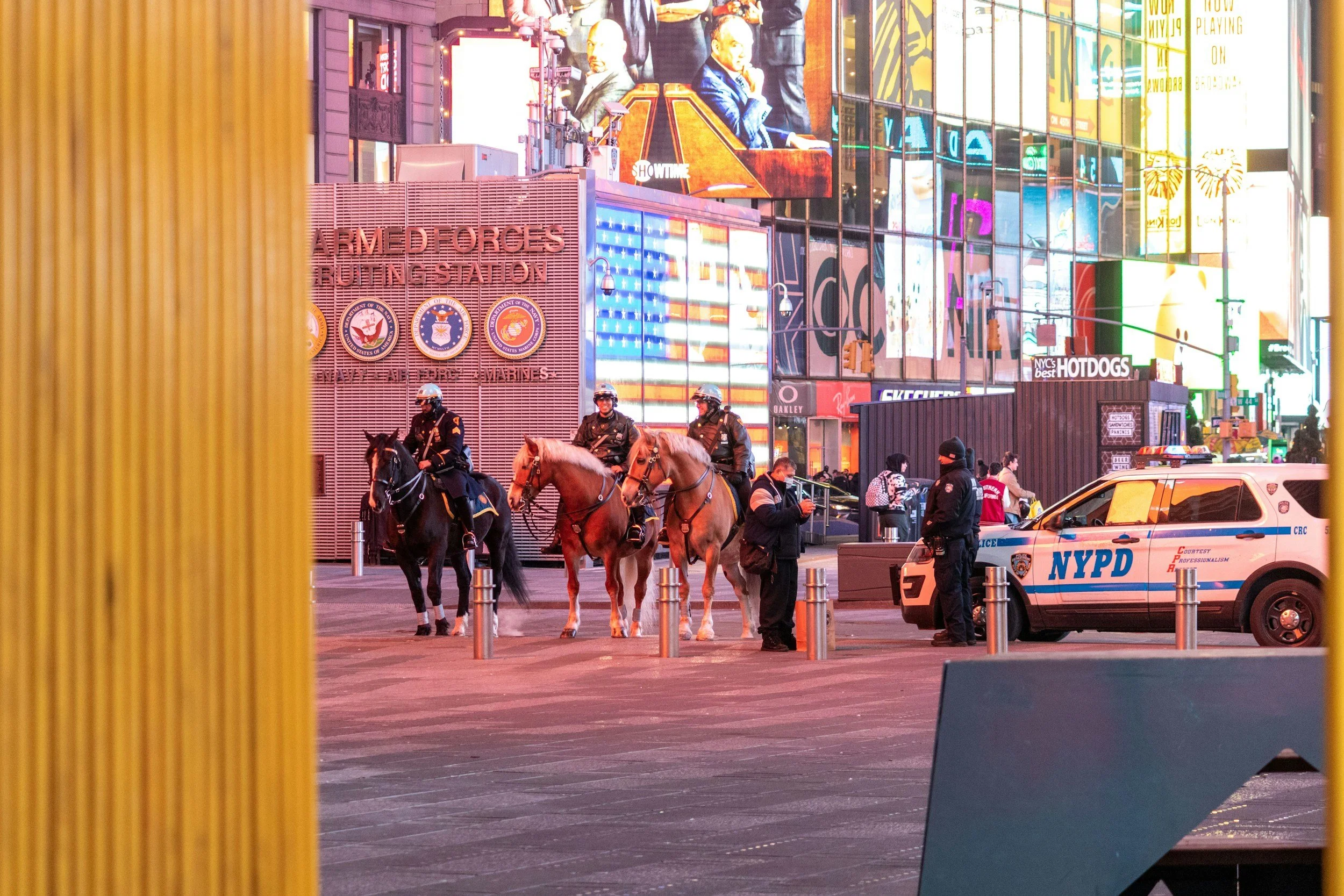
Subsequent developments have reinforced the model. Similar shielded-operation approvals have been issued to additional agencies, and the NYPD has expanded its operational DFR capability with dock-based drones deployed across multiple precincts in Brooklyn, the Bronx, and Manhattan.
3- Implications for Security Professionals
This regulatory advance illustrates the rapid maturation of autonomous systems for protective and public-safety missions. Agencies and private security providers that integrate drones effectively gain faster situational awareness, better resource allocation, and enhanced officer and community safety. Success, however, depends on rigorous training, clear operational protocols, transparent community engagement, and compliance with both FAA requirements and local privacy standards.
At O’Neil Security Group (OSG), we monitor these developments closely as part of our commitment to innovative, intelligence-driven security solutions. Whether supporting public-safety partners or private-sector clients, OSG emphasizes professional standards, proactive risk assessment, and the responsible integration of advanced technologies—including aerial systems—into layered protective programs.
The September 2024 NYPD approval represents a meaningful step toward safer, more efficient emergency response. It also underscores the importance of staying current with regulatory progress so that security organizations can adopt proven capabilities responsibly and at scale.
-
Skydio – “FAA Issues Revolutionary Approval to NYPD to Conduct Drone as First Responder Operations with no Visual Observers” (Jakee Stoltz, September 23, 2024). Primary source for the original OSG post and detailed technical explanation of the waiver.
The Drone Girl – Coverage of the NYPD FAA approval and its operational implications (September 30, 2024).
New York City Mayor’s Office / NYPD announcements – Official statements on the Drone as First Responder program expansion and operational deployments (November 2024).
FAA public communications and related public-safety waiver guidance on shielded operations and BVLOS authorizations.
Subsequent Skydio updates confirming additional agency approvals under the same shielded-operations framework.


By Josiah O’Neil
Founder and CEO, O’Neil Security Group
Josiah O’Neil is a seasoned security professional with experience as a private contractor, Special Agent with the Diplomatic Security Service, California law enforcement officer, and military service member. He leads OSG, an all-source security solutions provider focused on proactive protection and intelligence-driven operations.